
Sep 11, 2026
The CF-28 That Arrives 14 Months Later: Reconstructing Rationale vs. Exporting It
Event
Tuesday, September 29th 12:00 PM ET
Most customs brokerages measure compliance readiness by how well they track tariff changes. For example, getting a new proclamation on Friday evening and having the team read and start implementing it by Monday morning feels great. But while staying current gives you an edge in navigating the rules of the day, it does little else to prove which version was in effect 14 months ago when a Customs entry was filed.
That is what a CF-28 is actually asking. Unfortunately, for many brokerages, when it arrives, the tracking spreadsheet has been overwritten, and the entry writer may have moved on. The reason for the classification decision is buried in some email string that no one thought to save.
Rule-version provenance is the discipline that answers that question before it gets asked. It is a timestamped record of what regulation was in effect at the time of filing and determines whether a CF-28 response takes an afternoon or two weeks of reconstruction.
A CF-28 requests information from importers on compliance issues related to a specific entry. The CBP issues this customs form when it needs clarification on an aspect of the filing, such as product classification, country of origin, declared values, or duty calculations. At times, CF-28 requests are generated during routine import reviews. They can also result from audits of past import activity, and CF-28 responses may affect prior entries for up to 5 years.
Importers are usually given 30 days to respond. Responses must contain accurate product details, supporting documentation, and the basis for the classification code. "Every entry is a potential hotspot for further customs scrutiny and enforcement, which means auditing and re-auditing your entries," wrote Hugo Pakula, CEO of Tru Identity, in his August 2026 analysis.
The obvious problem is obtaining the documents and submitting a complete response before the deadline. The more difficult one is proving which version of the tariff rule was in effect when the entry was originally filed.
When a CF-28 arrives, the process is the same at most customs brokerages. One person plows through email threads with the customer; another pulls up the spreadsheet that tracked tariff changes, that is, if it hasn't been overwritten. If the original customs entry writer who filed the entry is still working at the business, they are included on the call.
The bigger problem is that regulations keep changing. For example, a Chapter 99 provision valid when a customs entry was filed through the port of San Francisco in February could be changed by a proclamation in April. If the brokerage has updated its database since that change, the February record may already be gone. Now, the broker has to choose which version of the rule was correct when it was filed, using a system built to show only what is currently true or accurate.
According to Pakula, "you are now competing with $3.5 billion worth of resources for enforcement on the CBP side." And failure to respond effectively could lead CBP to issue a CF-29 proposing or taking action on the entry.
Separately, CBP may assess penalties for negligence under 19 U.S.C. 1592 when the statutory requirements for a penalty are met. As Pakula wrote, brokerages should account for "penalties, demurrage, cost of responding to CF-29s, extra fees assessed due to downstream noncompliance" when calculating the actual cost of an entry.
Unfortunately, the hours spent reconstructing a filing rationale rarely appear in that calculation.
Rule-version provenance is the timestamp on each filing decision that records the regulation, ruling, or rate in effect when the customs entry was filed. A CF-28 arrives, and the broker pulls from a structured record created at the time of filing. There is no rebuilding because every record or entry was well preserved.
However, a licensed broker must play a significant role in determining what information is automatically generated by any tool's decision matrix that produces entry-relevant output. The broker's documented rationale must be captured in real time at the point of decision.
You also have to find all the other places where this thing is being imported and make sure that they're consistent with what CBP is doing. But that can be very difficult, which is why a master data management platform is very important.
A CF-28 response, with provenance, is based on the documented structure of the response record and not on reconstruction. Because the preparation was done at the point of entry, timely responses can reduce potential delays and penalties. Without it, the answer is whoever remembers and whatever data can be found.
Tru Identity records the provenance of the rule version at the time of filing. Each classification decision is annotated with the regulation in force at the time of the decision. At the time of publication, CSMS bulletins, rulings, proclamations, and Federal Register notices are ingested to keep the record current and traceable under the customs law.
This way, when a CF-28 arrives months later, the broker just exports the rationale, embedded within their existing workflow. The audit trail lists the rationale behind each decision and the regulatory reference for each filing.
Tru is the only AI trade compliance platform for customs brokerages selected by CBP to modernize how customs entries are built and filed. GHY, a customs brokerage using Tru Identity, has reduced the time it takes to review data from 1.5 hours to less than 10 minutes per client onboarding – and that review is now billable. Stallion Express, a 3PL that works with over 40,000 sellers, has had zero customs rejections since September 2025.
Chances are that the CF-28 will arrive. The question every broker should be asking now is whether the record that answers it was built at the time of filing or has to be pieced together from whatever remains 14 months later. Contact us today to get started.
Q1. How long do importers have to respond to a CF-28 customs form?
Importers typically have 30 days to respond to a CF-28. To avoid delays and penalties, importers should meet regulatory requirements by organizing their entry packages and file their supporting information or a complete response within the specified window. Missing the deadline allows CBP to issue a CF-29 based on whatever information they already have.
Q2. Can a CF-28 affect past entries and future customs clearance?
Yes. CF-28 responses can impact compliance for up to five years. CBP can review past import entries tied to the same product classification, origin, declared values, or duty calculations. If the review reveals errors, duties and taxes on previous entries may be reassessed. Future customs clearance can also be affected if the importer or broker is flagged for closer scrutiny on incoming cargo.
Q3. What documentation do customs brokers typically need when responding to a CF-28?
Customs brokers typically need export documents, origin certificates, purchase orders or commercial invoices, and importer or company records that support the original classification. The key reference is the merchandise description and the code used at filing. Brokers should advise their clients to obtain these details early to maintain response accuracy and address any discrepancies before the deadline.
Q4. How do government agencies use CF-28 data for trade services oversight?
Government agencies, including Customs and Border Protection, use CF-28 data to verify compliance across specific ports and trade services. Border protection agents review filing patterns for inconsistencies in values, origins, descriptions, or classifications. Exporters dealing with cross-border trade may be affected if the data reveals inconsistencies in related transactions.
Q5. What is the difference between a CF-28 and a CF-29 in the customs process?
A CF-28 is a request for information. A CF-29 is a notice of action. In brokerage services, the CF-28 provides the broker an opportunity to submit evidence through the ACE Portal, with supporting documents submitted through the Document Image System (DIS), before CBP makes a determination. If the response is late or incomplete, CBP may issue a CF-29 proposing or taking action on the entry, which can result in additional duties. Any customs penalties would arise through a separate enforcement process.
Sep 4, 2026
What "Responsible Supervision and Control" Actually Means Under 19 CFR 111
With CF-29 enforcement up 148% in Q2, "responsible supervision and control" is no longer theoretical, customs brokers need documented proof of who reviewed each entry, why they classified it that way, and which tariff rules applied at the time, or face penalties and license suspension
Aug 25, 2026
AI That Can't Be Supervised Is Not Compliant, Even When It's Right
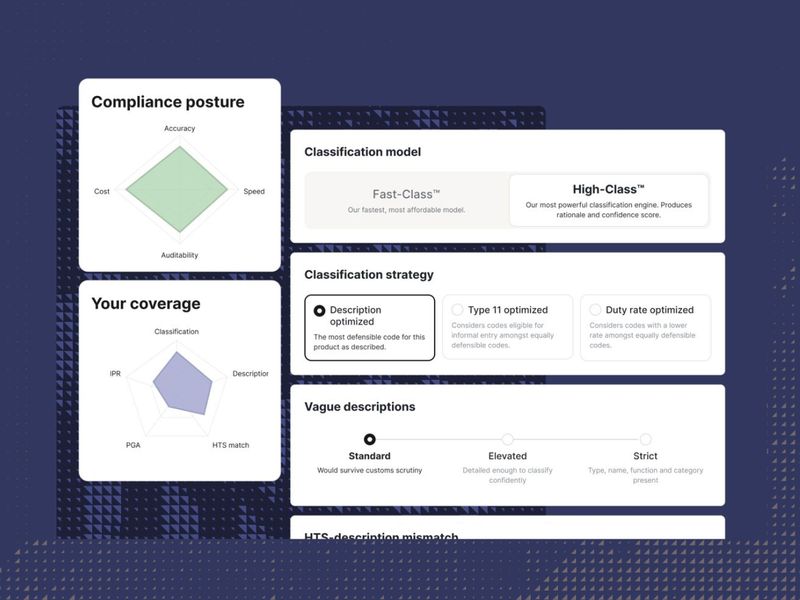
How a decision matrix keeps every automated determination traceable to your license holder.

©2026 Tru Identity, Inc. All rights reserved.